
Book
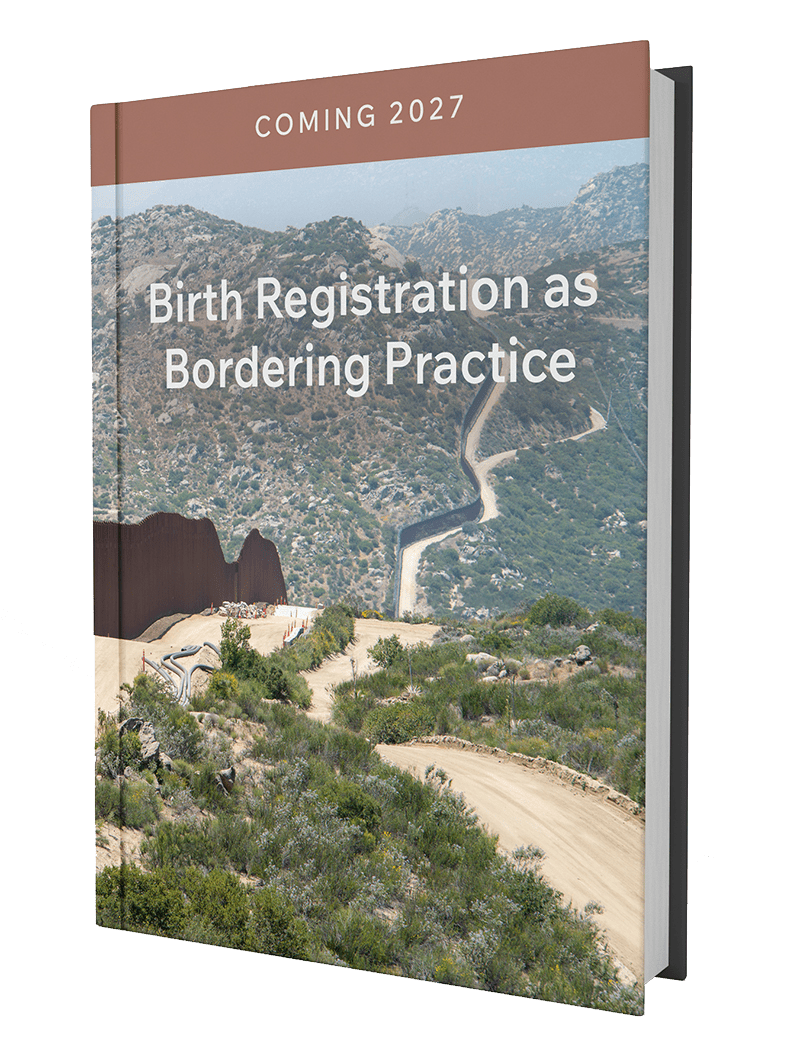
Birth Registration as Bordering Practice: How Migrants’ Children are Made Stateless around the World
Allison J. Petrozziello
Globally, 850 million people lack identity documents, including birth certificates. Most of the world’s paperless people are living in poverty in rural areas and belong to ethnic minority groups or racialized peoples. Some 150 million children under the age of five currently lack a birth certificate, and risk joining the world’s 15 million stateless people. Within countries, gaps in birth registration coverage map closely onto existing social inequalities based on gender, race, ethnicity, class, and geographic location. Lacking documentation and proof of legal citizenship, they will be unable to enjoy the full range of human rights. A global push is underway to achieve universal birth registration by 2030 as part of the UN Sustainable Development Agenda. At the same time, states seeking to control human mobility are enacting increasingly restrictive migration and border control measures at and beyond the physical border. What happens when the unregistered cross international borders, and have children of their own? Or when borders are brought to the unregistered, who are then issued documents identifying them as not-belonging?
Birth Registration as Bordering Practice tracks this little-known human rights challenge around the world, before taking an in-depth look at how multiple bordering practices block access to citizenship for descendants of Haitian migrants in the Dominican Republic. The book demonstrates that the problem is not merely the non-registration of birth, but rather that birth registration, as an exercise of state power, functions as a mechanism of inclusion/exclusion. When birth registration is made a bordering practice, children born to pregnant people on the move—and other multiply marginalized mothers—are made stateless for generations to come.
Birth Registration as Bordering Practice will be of academic interest to scholars and students in political science, sociology, law, migration studies, gender studies, citizenship and statelessness studies, social work, children and family studies, international development, global studies, human rights, history, geography, Latin American and Caribbean studies. It will also be of interest to development practitioners working on the legal identity agenda, and human rights advocates. As of September 2026, it is under contract with an anticipated publication date of mid-2027.